Showing posts with label conditional. Show all posts

MODAL VERBS DEFINITION AND USAGE


Modal verbs are auxiliary verbs (also called helping verbs) like can, will, could, shall, must, would, might, and should. After a modal verb, the root form of a verb is generally used. The word to should not appear after a modal verb. An exception is the phrase ought to, which is considered a modal verb.

Modal verbs add meaning to the main verb in a sentence by expressing possibility, ability, permission, or obligation.

You must turn in your assignment on time.

He might be the love of my life.

The doctor can see you now.

When a modal verb precedes the main verb in a sentence or clause, use the root of the verb rather than the infinitive, which contains the word to.

The doctor can to see you now.        (incorrect)

The one case in which we deviate from this rule and use the full infinitive form of a verb is with the modal phrase “ought to”

The doctor ought to see you now. (You’ve waited long enough.)

To Do as a Modal Verb

The verb to do  can be used as modal verb  or a main verb. In this sentence, to do is being used as a main verb and can is being used as a modal verb.

You can do it.

Whereas in this example, do is used as a modal verb.

You do know how to sing!

Remember, however, that do can be used as a modal verb only if there is no other modal verb present in the sentence.

Thank you, I can do sing.(incorrect)

Thank you, I do sing. (correct)

Thank you, I can sing. (correct).


What are modal verbs?
​

Modals (also called modal verbs, modal auxiliary verbs, modal auxiliaries) are special verbs which behave irregularly in English. They are different from normal verbs like "work, play, visit..." They give additional information about the function of the main verb that follows it. They have a great variety of communicative functions.
Here are some characteristics of modal verbs:

  • They never change their form. You can't add "s", "ed", "ing"...
  • They are always followed by an infinitive without "to" (e.i. the bare infinitive.)
  • They are used to indicate modality allow speakers to express certainty, possibility, willingness, obligation, necessity, ability


          Here's a list of the modal verbs in English:

can

could

may

might

will

would

must

shall

should

ought to

Modals are different from normal verbs:


1: They don't use an 's' for the third person singular.
2: They make questions by inversion ('she can go' becomes 'can she go?').
3: They are followed directly by the infinitive of another verb (without 'to').

Probability:

First, they can be used when we want to say how sure we are that something happened / is happening / will happen. We often call these 'modals of deduction' or 'speculation' or 'certainty' or 'probability'.

For example:

·         It's snowing, so it must be very cold outside.

·         I don't know where John is. He could have missed the train.

·         This bill can't be right. £200 for two cups of coffee!

Click here to find out more about probability.

Ability

We use 'can' and 'could' to talk about a skill or ability.

For example:

·         She can speak six languages.

·         My grandfather could play golf very well.

·         I can't drive.

Click here to find out more about ability.

Obligation and Advice

We can use verbs such as 'must' or 'should' to say when something is necessary or unnecessary, or to give advice.

For example:

·         Children must do their homework.

·         We have to wear a uniform at work.

·         You should stop smoking.

Click here to find out more about obligation

Permission

We can use verbs such as 'can', 'could' and 'may' to ask for and give permission. We also use modal verbs to say something is not allowed.

For example:

·         Could I leave early today, please?

·         You may not use the car tonight.

·         Can we swim in the lake?

Habits

We can use 'will' and 'would' to talk about habits or things we usually do, or did in the past.

For example:

·         When I lived in Italy, we would often eat in the restaurant next to my flat.

·         John will always be late!

Past modals

The past modals 'could have + past participle', 'should have + past participle' and 'would have + past participle' can be confusing. I explain about them here. Here's a list of the modal verbs in English:

can

could

may

might

will

would

must

shall

should

ought to

Modals are different from normal verbs:


1: They don't use an 's' for the third person singular.
2: They make questions by inversion ('she can go' becomes 'can she go?').
3: They are followed directly by the infinitive of another verb (without 'to').

Probability:

First, they can be used when we want to say how sure we are that something happened / is happening / will happen. We often call these 'modals of deduction' or 'speculation' or 'certainty' or 'probability'.

For example:

·         It's snowing, so it must be very cold outside.

·         I don't know where John is. He could have missed the train.

·         This bill can't be right. £200 for two cups of coffee!

Click here to find out more about probability.

Ability

We use 'can' and 'could' to talk about a skill or ability.

For example:

·         She can speak six languages.

·         My grandfather could play golf very well.

·         I can't drive.

Click here to find out more about ability.

Obligation and Advice

We can use verbs such as 'must' or 'should' to say when something is necessary or unnecessary, or to give advice.

For example:

·         Children must do their homework.

·         We have to wear a uniform at work.

·         You should stop smoking.

Click here to find out more about obligation

Permission

We can use verbs such as 'can', 'could' and 'may' to ask for and give permission. We also use modal verbs to say something is not allowed.

For example:

·         Could I leave early today, please?

·         You may not use the car tonight.

·         Can we swim in the lake?

Habits

We can use 'will' and 'would' to talk about habits or things we usually do, or did in the past.

For example:

·         When I lived in Italy, we would often eat in the restaurant next to my flat.

·         John will always be late!


 COULD


 SHOULD


SHOULD HAVE


OUGHT TO


MUST


Share:

MAY AND MIGHT


MAY AND MIGHT

Level: beginner

We use may:

·         when we are not sure about something in the present or future:

Jack may be coming to see us tomorrow.
               (= Perhaps Jack will come to see us tomorrow.)
Oh dear! It's half past ten. We may be late for the meeting.
               (= Perhaps we will be late for the meeting.)
She's had no sleep. She may be tired.
               (= Perhaps she is tired.)

·         to ask for permission in a formal way:

May I borrow the car tomorrow?
May we come a bit later?

·         to give permission in a formal way:

You may go now.
You may come at eleven if you wish.

·         to say that someone has permission in a formal way:

Students may travel for free.

We can use may not to refuse permission or to say that someone does not have permission, but it is formal and emphatic:

You may not borrow the car until you can be more careful with it!
Students may not wear jeans.

We use might when we are not sure about something in the present or future:

I might see you tomorrow.
It looks nice, but it might be very expensive.
It's quite bright. It might not rain today.

Level: intermediate

We use may have and might have to make guesses about the past:

I haven't received your letter. It may have got lost in the post.
It's ten o'clock. They might have arrived by now.

We also use might:

·         as the past tense of requests with may:

He asked if he might borrow the car.
They wanted to know if they might come later.

·         as a very polite way of asking for permission:

Might we ask you a question?
Might I just interrupt for a moment?

Questions and negatives

Level: beginner

We make questions by putting the subject after may/might:

May I …?     Might I …?

The negative forms are may not and might not.

'may' and 'might'

Level: beginner

We use may:

·         when we are not sure about something in the present or future:

Jack may be coming to see us tomorrow.
               (= Perhaps Jack will come to see us tomorrow.)
Oh dear! It's half past ten. We may be late for the meeting.
               (= Perhaps we will be late for the meeting.)
She's had no sleep. She may be tired.
               (= Perhaps she is tired.)

·         to ask for permission in a formal way:

May I borrow the car tomorrow?
May we come a bit later?

·         to give permission in a formal way:

You may go now.
You may come at eleven if you wish.

·         to say that someone has permission in a formal way:

Students may travel for free.

We can use may not to refuse permission or to say that someone does not have permission, but it is formal and emphatic:

You may not borrow the car until you can be more careful with it!
Students may not wear jeans.

We use might when we are not sure about something in the present or future:

I might see you tomorrow.
It looks nice, but it might be very expensive.
It's quite bright. It might not rain today.

Level: intermediate

We use may have and might have to make guesses about the past:

I haven't received your letter. It may have got lost in the post.
It's ten o'clock. They might have arrived by now.

We also use might:

·         as the past tense of requests with may:

He asked if he might borrow the car.
They wanted to know if they might come later.

·         as a very polite way of asking for permission:

Might we ask you a question?
Might I just interrupt for a moment?

Questions and negatives

Level: beginner

We make questions by putting the subject after may/might:

May I …?     Might I …?

The negative forms are may not and might not.


 PICTURE#01


PICTURE #02

Share:

CONDITIONAL SENTENCES


Conditional Sentences are also known as Conditional Clauses or If Clauses. They are used to express that the action in the main clause (without if) can only take place if a certain condition (in the clause with if) is fulfilled. There are three types of Conditional Sentences.

Conditional Sentence Type 1

→ It is possible and also very likely that the condition will be fulfilled.

Form: if + Simple Present ,will-Future

Example: If I find her address, I’ll send her an invitation.

Form

if + Simple Present, will-Future

Example: If I find her address, I will send her an invitation.

The main clause can also be at the beginning of the sentence. In this case, don't use a comma.

Example: I will send her an invitation if I find her address.

Note: Main clause and / or if clause might be negative. See Simple Present and will-Future on how to form negative sentences.

Example: If I don’t see him this afternoon, I will phone him in the evening.

**************

Use

Conditional Sentences Type I refer to the future. An action in the future will only happen if a certain condition is fulfilled by that time. We don't know for sure whether the condition actually will be fulfilled or not, but the conditions seems rather realistic – so we think it is likely to happen.

Example: If I find her address, I’ll send her an invitation.

I want to send an invitation to a friend. I just have to find her address. I am quite sure, however, that I will find it.

Example: If John has the money, he will buy a Ferrari.

I know John very well and I know that he earns a lot of money and that he loves Ferraris. So I think it is very likely that sooner or later he will have the money to buy a Ferrari.


Conditional Sentence Type 2

→ It is possible but very unlikely, that the condition will be fulfilled.

Form: if + Simple Past ,Conditional (= would + Infinitive)

Example: If I found her address, I would send her an invitation.


Form

if + Simple Past, main clause with Conditional I (= would + Infinitive)

Example: If I found her address, I would send her an invitation.

The main clause can also be at the beginning of the sentence. In this case, don't use a comma.

Example: I would send her an invitation if I found her address.

Note: Main clause and / or if clause might be negative. See Simple Past and Conditional on how to form negative sentences.

Example: If I had a lot of money, I wouldn’t stay here.

Were instead of Was

In IF Clauses Type II, we usually use ‚were‘ – even if the pronoun is I, he, she or it –.

Example: If I were you, I would not do this.

Conditional Sentences Type II refer to situations in the present. An action could happen if the present situation were different. I don't really expect the situation to change, however. I just imagine „what would happen if …“

Example: If I found her address, I would send her an invitation.

I would like to send an invitation to a friend. I have looked everywhere for her address, but I cannot find it. So now I think it is rather unlikely that I will eventually find her address.

Example: If John had the money, he would buy a Ferrari.

I know John very well and I know that he doesn't have much money, but he loves Ferraris. He would like to own a Ferrari (in his dreams). But I think it is very unlikely that he will have the money to buy one in the near future.


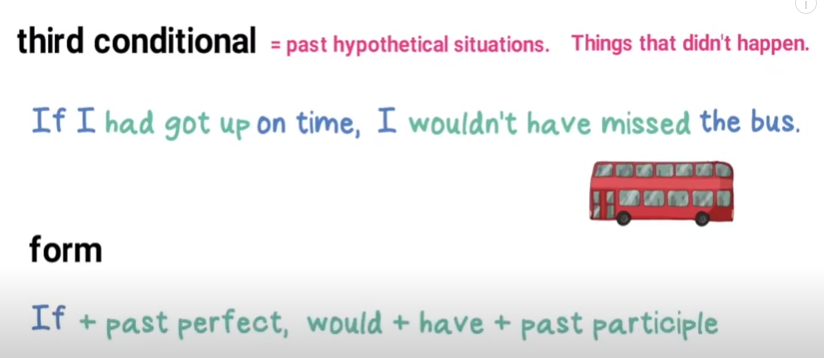
Conditional Sentence Type 3

→ It is impossible that the condition will be fulfilled because it refers to the past.

Form: if + Past Perfect ,Conditional  (= would + have + Past Participle)

Example: If I had found her address, I would have sent her an invitation.

Form

if + Past Perfect, main clause with Conditional II

Example: If I had found her address, I would have sent her an invitation.

The main clause can also be at the beginning of the sentence. In this case, don't use a comma.

Example: I would have sent her an invitation if I had found her address.

Note: Main clause and / or if clause might be negative. See  Past Perfect and Conditional on how to form negative sentences.

Example: If I hadn’t studied, I wouldn’t have passed my exams.

Use

Conditional Sentences Type III refer to situations in the past. An action could have happened in the past if a certain condition had been fulfilled. Things were different then, however. We just imagine, what would have happened if the situation had been fulfilled.

Example: If I had found her address, I would have sent her an invitation.

Sometime in the past, I wanted to send an invitation to a friend. I didn't find her address, however. So in the end I didn't send her an invitation.

Example: If John had had the money, he would have bought a Ferrari.

I knew John very well and I know that he never had much money, but he loved Ferraris. He would have loved to own a Ferrari, but he never had the money to buy one.


Exceptions

Sometimes Conditional Sentences Type I, II and III can also be used with other tenses.


So far you have only learned the basic rules for Conditional Sentences. It depends on the context, however, which tense to use. So sometimes it's possible for example that in an IF Clause Type I another tense than Simple Present is used, e.g. Present Progressive or Present Perfect .

Conditional Sentences Type I (likely)

Condition refers to:

IF Clause

Main Clause

future action

Simple Present

If the book is interesting, …

Future I

…I will buy it.

Imperative

…buy it.

Modal Auxiliary

…you can buy it.

action going on now

Present Progressive

If he is snoring, …

Future I

…I will wake him up.

Imperative

…wake him up.

Modal Auxiliary

…you can wake him up.

finished action

Present Perfect

If he has moved into his new flat, …

Future I

…we will visit him.

Imperative

…visit him.

Modal Auxiliary

…we can visit him.

improbable action

should + Infinitive

If she should win this race, …

Future I

…I will congratulate her.

Imperative

…congratulate her.

************


Share:

Contact Us

Name

Email *

Message *

Search This Blog

Powered by Blogger.

About Me

My photo
My Name is NI NENGAH DESSI.I am a blogger.Female.I am a Balinese.Indonesia is my country.

SEGEHAN HARI RAYA NYEPI

  Kemarin banyak yang tanya Segehan yg 11tanding itu untuk dimana Ini saya share ulang yang lebih lengkap. ✓ Tri Mala Paksa, yaitu Bhuta Buc...